
By Sophie Armor Analytics Manager, Albertsons Media Collective
What is Lifetime Value (LTV)?
Lifetime Value (LTV) represents the projected revenue customers are expected to generate throughout their relationship with a brand at Albertsons. Our framework specifically evaluates customer value over a 52-week horizon, extending beyond short-term transactions to capture the sustained financial impact of customer relationships.

Why does this matter?
- Captures the long-term impact of campaigns: Traditional metrics like ROAS often focus on immediate returns, but LTV allows us to assess how marketing efforts influence behavior over time.
- Shifts focus from ad efficiency to customer-centric value: Instead of relying solely on Return on Ad Spend (ROAS), which can undervalue campaign impact, LTV encourages a deeper understanding of who our buyers are, how valuable they are, and how we can influence their behavior to maximize profitability.
By integrating LTV into our analytics, we retain ROAS as a familiar benchmark while enriching it with forecasted insights. This dual approach helps prevent underinvestment in marketing efforts and supports smarter allocation of marketing resources.
Motivation for Building LTV
Our initial Lifetime Value (LTV) framework is not designed for targeting—it was built for reporting and storytelling. The goal was to deepen our understanding of customer behavior and continuously enhance our data capabilities.
While LTV offers broad strategic value, it also delivers specific benefits for our existing measurement and reporting infrastructure.
We desired a way to:
- Enrich brand-level insights for a given CPG with value metrics and quantify brand buyers within campaign reporting. (We’ll explore buyer groups in the next section.)
- Rapidly develop a scalable, data-driven framework that integrates seamlessly into existing pipelines.
- Support Retail Media Network (RMN) investment and strategies, such as customer acquisition, with long-term value projections.
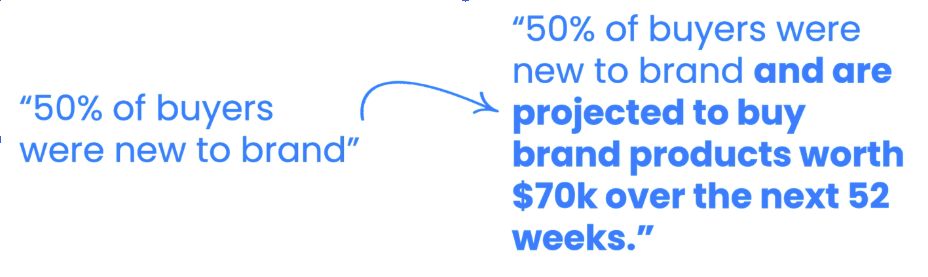
This shift transforms campaign reporting from a static snapshot into a dynamic narrative—one that highlights both immediate performance and long-term potential.
To move quickly and ensure scalability, we chose to aggregate LTV at the brand level rather than predict individual customer value. This approach allows us to:
- Leverage existing buyer segmentation structures.
- Integrate seamlessly into current reporting workflows.
- Generate consistent, repeatable insights across campaigns.
By focusing on buyer groups rather than individual predictions, we’ve created a production scale framework that supports LTV measurement across brands that are measured in a campaign —without the complexity of customer-level modeling.
Existing Brand Buyer Framework
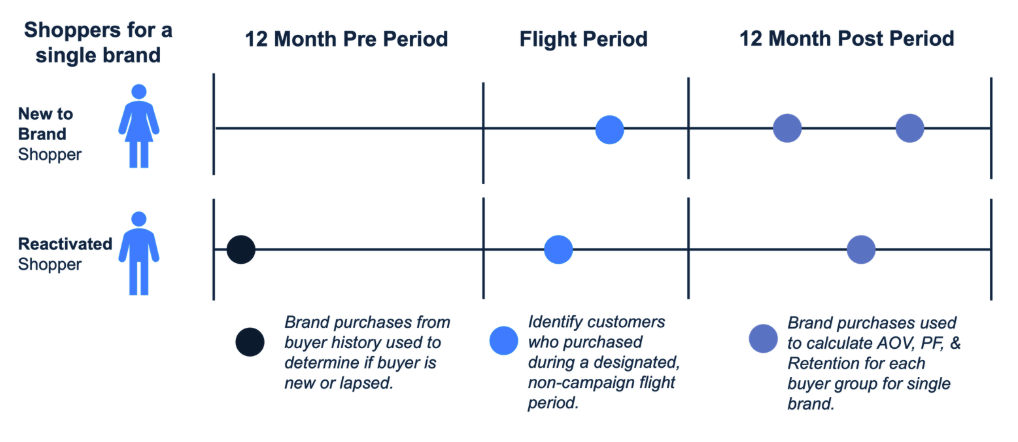
An existing measurement framework that The Collective offers its advertisers is the 'buyers analysis'. In buyers analysis, we group customers based on their relationship with the brand prior to the marketing campaign. In reporting – this would indicate which group was reached, converted, and therefore drove revenue.
- New-to-Brand Buyers: These are customers who had not made any purchases from the brand in the 52 weeks prior to the campaign. Their first recorded transaction with the brand occurred during the campaign period, indicating that the campaign successfully attracted new customers.
- Repeat Buyers: These buyers had made 1 to 2 purchases from the brand in the 52 weeks before the campaign. These buyers show signs of engagement and potential for growth.
- Lapsed (Reactivated) Buyers: Customers who made at least one purchase in the second half of the 52-week period (i.e., 26–52 weeks ago), but did not purchase in the first half (i.e., 0–26 weeks ago), and did make a purchase during the campaign. These buyers had disengaged but were successfully reactivated by the campaign. Note - Lapsed Buyers are not mutually exclusive—they can also be part of the Repeat or Loyal groups depending on their total purchase count.
- Loyal Buyers: These are customers who made 3 or more purchases in the 52 weeks leading up to the campaign. Their behavior reflects strong brand affinity, and the campaign helped maintain or deepen their loyalty.
Our Lifetime Value measurement is currently centered on new and reactivating lapsed buyers, whose behavior is more directly influenced by advertising and promotional efforts. This focus allows us to attribute projected future value to specific campaigns, as these segments exhibit clearer engagement signals and incremental value potential.
How do we Calculate Lifetime Value
For each brand buyer group, we calculate metrics independently. For example, when analyzing new customers from a branded campaign, we examine historical 52-week purchase trends to establish expected behavior, which serves as the foundation for each metric.
Note, the values included in this section are just for demonstration purposes.
Key Inputs and Formula Components
- Average Order Value (AOV)
- Total revenue ÷ number of purchases
- Reflects the average amount a customer spends per transaction.
- Purchase Frequency (PF)
- Number of purchases ÷ number of customers
- Measures how often the average customer makes a purchase over a one-year period.
- Customer Value (CV)
- AOV x PF
- Indicates the average historical value of a customer before factoring in retention or likelihood of future purchase behavior.
- Retention Rate
- Number of customers who remained 52 weeks post-period ÷ number of customers who purchased during a set period.
- Reflects the percentage of customers who continue to engage with the brand over a 52-week period. It reflects customer affinity and can also be interpreted as the likelihood of a customer making a repeat purchase within a year.
- Buyer-Level Lifetime Value (LTV)
- AOV x PF x Retention Rate
- Projects the future revenue per buyer by combining historical value with retention likelihood, tailored to a 52-week timeframe.
- Number of Buyers
- Campaign specific buyer distribution results, such as

Numbers are for demonstration and not real results.
- Quantifies the distribution of attributed purchasers across buyer groups, based on their historical engagement with the brand(s).
- Total Lifetime Value for Buyer Group
- Buyer-Level LTV x # Buyers
- Calculates the total projected value for each buyer group within a campaign.
Example of Key Components for New and Lapsed Buyer Groups for a Single Campaign
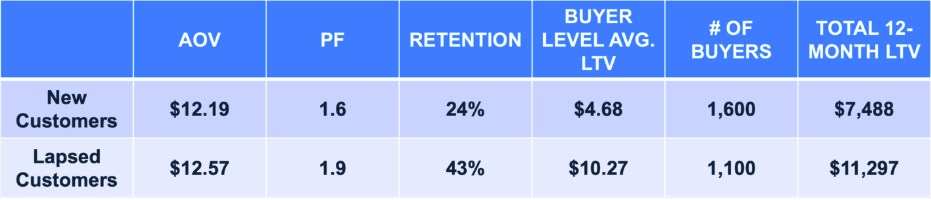
Numbers are for demonstration and not real results.
Validation
While predicting future behavior—especially for new customers—is inherently challenging, our methodology has demonstrated strong alignment with historical campaign outcomes. We observe a median variance of approximately 15%, which we consider a solid benchmark given the model’s simplicity, speed, and ease of integration into existing workflows.
Rather than targeting perfect precision at the individual level, our approach emphasizes directional accuracy to support confident, scalable storytelling. The strength of this framework lies in its efficiency and adaptability, enabling rapid validation cycles and continuous refinement.
Use of Lifetime Value
Group-Level LTV enhances our reporting in several keyways:
- Brand-Level Insights: Adds depth to campaign performance metrics and bolsters our advertisers’ understanding of the true value of a campaign.
- Customer Acquisition Impact: Quantifies the value of new and reactivated buyers.
- Investment Justification: Supports long-term RMN strategies with future revenue projections.
By pairing LTV with ROAS, we create a more complete picture of campaign success—one that balances short-term efficiency with long-term growth.
We are working towards democratizing access to this data by making it available to advertisers. This ensures that LTV is not just a concept, but a practical tool for decision-making.

What’s Next: Evolving Our LTV Framework
We will continuously improve our LTV model to make it more dynamic and predictive. Future enhancements include:
- Customer-Level Predictions: Moving from group averages to individual forecasts.
- Purchase Cycle Integration: Accounting for seasonal and behavioral patterns.
- Longitudinal Measurement / Journey Mapping: Understanding how new and reactivated customers become loyal.
As we continue to refine our approach, LTV will play a central role in transforming how we measure and report on digital campaign success.
Want to learn more about how we measure client success? Reach out to mediacollective@albertsons.com