Retail Media is booming, but the way we measure its success leaves something to be desired.

Photo Credit: Ovative Group
"At Albertsons Media Collective, we’ve consistently heard a thoughtful question from our brand and agency partners: 'How can we better understand the differences in ROAS across campaigns and platforms?'"
To answer this, we partnered with the brilliant minds at Ovative Group and Northwestern University - Kellogg School of Management to create greater transparency and understanding around the differences in ROAS methodologies across RMNs in an effort to arm advertisers with tools to support conversations with their RMN partners and within the industry. The result? A first-of-its-kind whitepaper that pulls back the curtain on ROAS methodology. What we found might surprise you.
Key Insights:

These insights aren’t just theoretical—they’ve already sparked meaningful industry dialogue. In May, our Head of Marketing Science Research Levi Dantzinger took the stage at #SHOPPER2025, presented by the Advertising Research Foundation (ARF), to unveil the whitepaper’s findings alongside our partners at Ovative Group and Northwestern University - Kellogg School of Management.
The session drew strong engagement from marketers, analysts and retail leaders eager to unpack the nuances of ROAS and explore a more transparent path forward. From that experience and from what we uncovered through our research, here are the key insights we want to make sure you know:
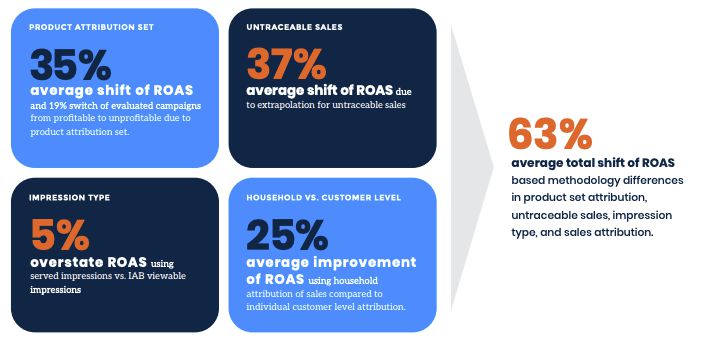
Photo Credit: Ovative Group
- The 60% Swing: Across 573 campaigns, we discovered that ROAS can swing by more than 60% depending on how it’s calculated. That’s not a typo. Sixty percent. Why? Because ROAS outcomes vary. From household vs. customer-level attribution to untraceable sales and impression types, the choices made behind the scenes can dramatically alter the story your data tells.
- Methodology Transparency is the Missing Link: Most advertisers assume ROAS is a standardized metric, but our research shows that methodological opacity is the norm, not the exception. Many RMNs don’t disclose whether they use incrementality, attribution windows, or customer matching logic, leaving advertisers in the dark about what their ROAS actually reflects. This lack of transparency makes it nearly impossible to compare performance across platforms or optimize spend with confidence.
- A New Framework for Smarter Investment Decisions: Our whitepaper introduces a Retail Media Measurement Framework that helps advertisers evaluate ROAS through five critical components: 1. Product Attribution Set, 2. Untraceable Sales, 3. Media Attribution, 4. Household vs. Customer Level Sales Attribution, and 5. Impression Type.
This framework empowers marketers to ask smarter questions, demand clarity from partners, and ultimately make more informed investment decisions.
What This Means for Advertisers: Moving Beyond ROAS
If you’re comparing ROAS across RMNs without understanding the methodology behind it, you might be making million-dollar decisions on shaky ground.
Performance metrics are intended to help advertisers understand the impact of their advertising investments on customers. Our analysis proves that within Retail Media, ROAS cannot fulfill this need. The differences in RMN methodologies, either driven by choice or by the nature of a retailer’s business, means advertisers cannot rely on ROAS to make performance comparisons or optimizations across RMNs, between retail media and national media, or even sometimes between channels on a single RMN.
Given significant shortfalls in ROAS as a metric, we believe the industry needs to shift performance conversations away from ROAS to incremental ROAS (iROAS). Like ROAS, approaches to iROAS are varied and complex, creating challenges in understanding and comparability.
Our Retail Media ROAS Demystified whitepaper arms advertisers with the right questions and push the industry toward greater transparency.
What’s Next? Let’s Talk!
The next stage of our work aims to outline approaches to measuring iROAS (including randomized control trials (RCTs), proxy matches, and synthetic models) and the advantages and limitations of each. We will demonstrate how different limitations in iROAS approaches can drive different performance outcomes and provide a question guide for advertisers to support engagement with their partner RMNs on iROAS.